Monday, September 16, 2019

PARLOPHONE

PARLOPHONE


With more than a century of experience in discovering and nurturing iconic recording artists,
Parlophone is among the most famous and prestigious companies in the history of the music
industry. The London-based PLG (Parlophone Label Group) joined Warner Music Group in 2013,
bringing to the WMG family artists such as Coldplay, David Guetta, Lily Allen, Kylie Minogue,
Damon Albarn, and the world-renowned EMI Classics label. Originally founded in Germany in
1896, with its British arm established in 1923, the Parlophone catalog includes such
groundbreaking artists as Pink Floyd, David Bowie, Radiohead, Jethro Tull, Kate Bush, and
many more. PLG is also home to FFRR, the dance music label formed by English DJ Pete
Tong in 1986.


With its broad and diverse roster of new stars and legendary artists, Warner Music Group is
home to a collection of the best-known record labels in the music industry including Asylum,
Atlantic, East West, Elektra, FFRR, Fueled by Ramen, Nonesuch, Parlophone, Rhino,
Roadrunner, Sire, Warner Bros., Warner Classics and Warner/Chappell Music, one of the
world’s leading music publishers with a catalogue of more than one million copyrights worldwide.


For more than four decades, WMG has been an industry-leading force in providing a
world-class array of services designed to help artists and labels grow their careers and their
businesses. Artist & Label Services is the umbrella for WEA (Warner-Elektra-Atlantic) – the
pioneering WEA distribution and marketing network – and Alternative Distribution Alliance
(ADA) – the ground-breaking global distribution company for independent artists and labels.

COLUMBIA

COLUMBIA

Columbia Records is an American record label owned by Sony Music Entertainment,
a subsidiary of Sony Corporation of America, the North American division of Japanese
conglomerate Sony. ... Columbia is the oldest surviving brand name in the recorded sound
business, and the second major company to produce records.


Columbia Records originated in the late 1880s as the Columbia Graphophone Company of
Bridgeport, Connecticut. The original company was built upon the experiments of scientist
Charles Sumner Tainter and Chichester A. Bell. Bell, a cousin of telephone inventor Alexander
Graham Bell, was an engineer. In 1886 the two received a patent for a wax-coated cardboard
cylinder on which sounds could be recorded. Their machine, the Graphophone, made its official
debut in Washington, D.C., three years later.


The relationship between Sony Corporation and Columbia Records dates back to 1968, when
CBS, which then owned the Columbia label, joined with Sony in order to expedite its expansion
into the Asian market. Twenty years later, Sony acquired the CBS Records Group. Sony Music
Entertainment Inc., including the Sony division of which Columbia Records is a part, is a truly
international recording company boasting more than 9,000 employees.


As one of four label groups within Sony Music Entertainment Inc., Columbia Records does not
independently report its financial results; they are included in the Sony Corporation's posted net
earnings. For fiscal 1998, ended March 31, 1998, SMEI reported net earnings of $1.67 billion on
revenue of $50.73 billion, compared with net income of $1.13 billion on revenue of $45.7 billion
in fiscal 1997. In fiscal 1996, Sony's reported net earnings of $512 million on revenue of $43.3
billion, compared with a net loss of $3.3 billion on revenue of $44.8 billion in fiscal 1995.
Ownership: Columbia Records is a division of Sony Music Entertainment Inc. which is a
division of Sony corp.
Employees: 9,000 in Sony Music Entertainment, Inc., which includes Columbia Records


In 1998, in a market saturated with new, high-priced musical products, the company adopted
a new strategy: the "developing-artists retail program." With this approach, prices for albums by
lesser-known, newer bands would be reduced until a certain quota were sold. Once the albums
passed the targeted sales threshold, the price per recording would be raised to that of better
known artists. This strategy encourages consumers to try unknown artists without having to
spend the same amount of money they traditionally would have spent on an established artist.

TASK 1

MUSIC MARKETING 


TASK 1: PRODUCT ANALYSIS: Music Videos
Colombia 


  • James Arthur- ‘Say you won’t let go’
Goodwin (media language)
Semiotics:
-mise en scene
-cinematography
-editing
-sound
This music video is a mixture of linear narrative music video since it follows a storyline from
the beginning (when they meet as young people) to end (when they're both old and the wife is
lying in hospital) and performance since we see shots of him performing the song. The artist is
singing about a woman he loves and throughout the video we see snapshots of their life
together. We see a man figure which appears to be James- however younger with a woman
whom he is singing about. The music video cuts between two main settings- one being in what
looks like a living room where James is sat playing his guitar and singing. Then throughout the
whole video we can shots of a couple spending time together. According to the lyrics this is
how they met. The video begins with close up shots of the artist- James who is constantly
looking away from the camera, remembering all the times spent with the girl: this is specifically
what makes the music video emotional. Close-up shots make music videos very personal
which it effective in this case since the music video is about love. We see things from the artists
point of view. There are also times were extreme close ups are used. This further conveys the
artists thoughts and feelings.Majority of the feeling is made using an eye level camera
angle- this is to show us the world as we would see it in real life to make us more engaged in
the music video and feel like we are a part of it. As James sings the words of the song “Just
say you won’t let go” we see a baby grabbing onto a man’s hand. This scene shows the both
of them being together in the end and starting a family. This concept was explored by Goodwin
who stated that in music videos ‘there is a  relationship between music and visuals’, in this case
it is to illustrate. The whole music video is made black and white- making it seem


Audience: How it is targeted 

Since the song suits a particular music genre for specifically from teenagers to people in their
early 30's, this is also how the music video has been targeted.  


  • The Script- ‘Superheroes’
Mise en scene
The music video is set in Johannesburg, South Africa what looks to be a less developed area,
with people gathering around the band waiting for them to perform just when the music starts
playing. This music video is also a mixture between a performance video and narrative. The
majority of the music video is of the band performing their song in front of a bunch of people with
a story to go with it of a man leaving his daughter to go to work in a suit. The following shots are
close ups of his facial expressions which show feelings of exhaustion, sadness and possibly guilt.
Overall the music video uses the character of the father as the ‘Superhero’ and he is ‘working every
day and night’ to earn money for his daughter. The story ends when the father comes back from work
and they both join the live performance where the band is- symbolizing happiness.
Cinematography
The video uses a lot of close up shots of the man when he is walking to work potentially to
illustrate his exhaustion at having to work so hard and possibly to create a sense of sympathy
in the audience's mind. 

Representation 
The music video is trying to represent the poor people in Africa who live in almost poverty.
At the start of the music video we see them gathering themselves around the band to listen to
their music. They all seem to be enjoying themselves and having fun despite of their living
conditions. Later on in the music video we see a father leaving his daughter in order to go to
work which further amplifies the struggle these people have to see. As the video progresses
we see that the father waking miles in order to get to his work and finally ends up collecting
rubbish. The music video is, overall, attempting to portray the pain and struggle of these
people and present them as the real ‘superheroes’ who have to leave everything behind and
go to work in order to provide for their families.


Parlophone
  • Coldplay- ‘Hymn for the weekend’
Mise en scene
The music video is set in Mumbai, India where the video highlights indian culture as bright
and colourful. The setting also appears to be natural and relaxed. Beyonce, who features
in the music video is portrayed as a Bollywood actress with all flashy clothes, loads of jewellery,
an awkward headgear and hands decorated in henna. The use of high key lighting shots
highlight the bright and vibrant colours of the indian culture.

Cinematography
The music video starts off with an establishing shot to give an overview of the whole setting.
It begins with a few medium shots which cut to a few close ups to show Martin singing.
Throughout the whole music video the camera moves in a smooth and unique way to
reinforce a sense of ease and comfort- possibly which is used to represent the Indian culture.
Slow motion is used when we see a boy doing a backflip, this shows how careless life is
and the use of slowing the video down gives a feel of their fun lasting forever.

Sound
At the start of the music video natural diegetic sounds are used when we hear the sound
of birds and traditional music to show the peacefulness of India

How is audience targeted?
Since the music video contains context of India's culture, this would appeal to 30+ year olds.


  • Paul Mccartney- Queenie eye
Semiotic analysis
Performance music video- main artist is playing on the piano and singing the song
With every verse a new person is added which also reflects the music becoming more fast
paced and upbeat. When we look at the scene from the music technicians point of view who
is standing upstairs- we don't see those people anymore. This shows us that the whole music
video is happening in Paul Mccartney’s head. The music he is playing is making him imagine this.
Sound
Dialogue before the music video starts- acts like an introduction to what is going to happen.
Cinematography
The camera zooms in to give a close up shot of each individual- they’re all either
dancing to the beat of the song or signing on the floor with their headphones on and vibing
to the music. 

Representation
The people are all of different ages and ethnicity- showing a sense of community
and how his music brings people together. 


Thursday, September 12, 2019

TASK 2


TASK 2: SEMIOTIC ANALYSIS: Existing music magazines- Billboard

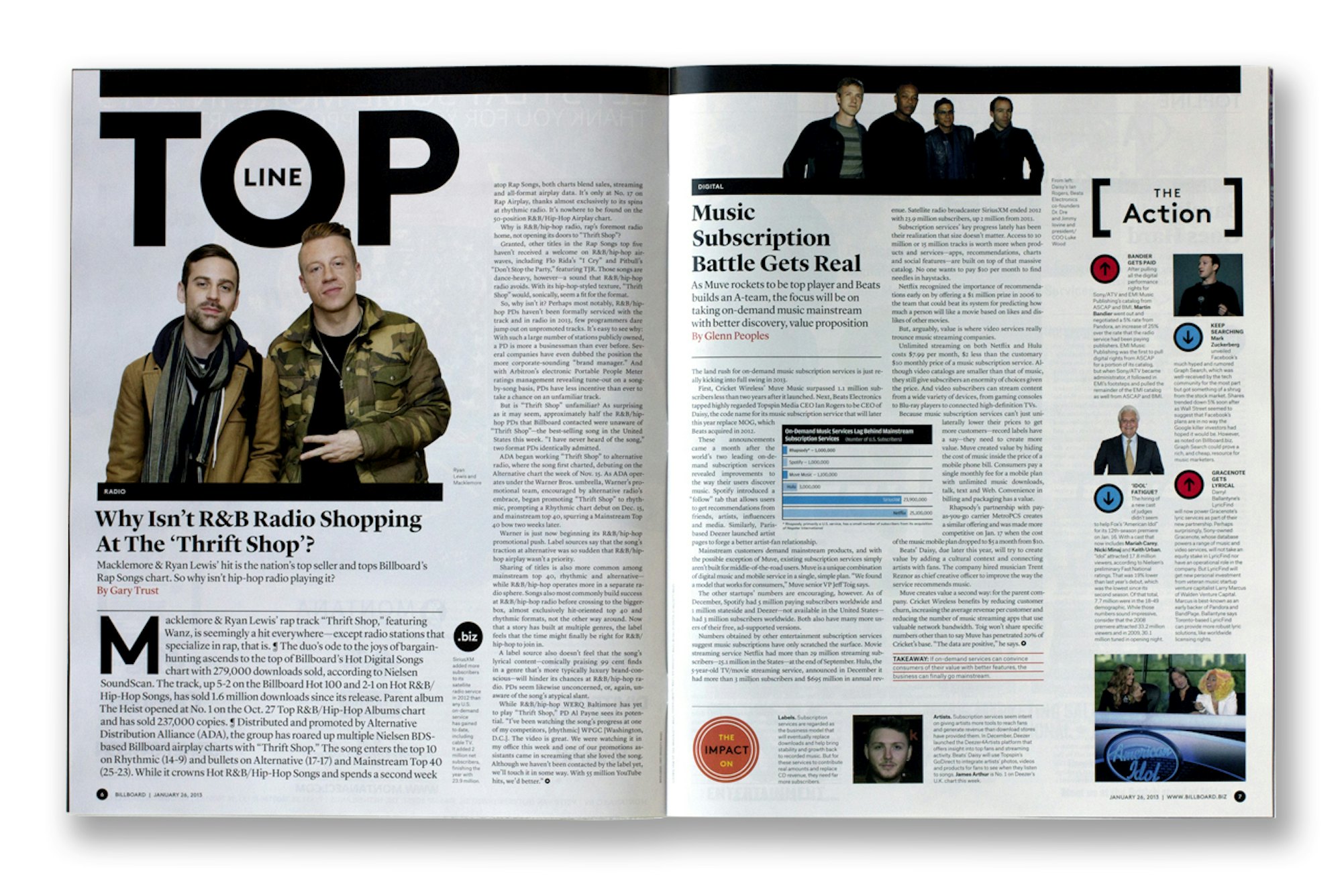
'Billboard magazine' is an American entertainment media brand known for its music charts and tracking most popular songs and albums in different genres.

Main image: Takes up ⅓ of the page reinforcing her importance/ relevance in the magazine. This is a medium shot, showing just a bit of her legs, however cutting them off a little bit. The attention is drawn to her body highlighting her sex appeal. She is portrayed as kind of a Goddess with the deep look she is giving. Her makeup and hair are done- making her look like glamorous just like a proper pop-star.  

The lighting is red/ orangey on the whole front cover- this possibly creates a sense of
intimacy and passion possibly reflecting her music genre since her songs are generally
about love.The bottom of the cover seems blurry alluding to a nature of secrecy and
mystery either towards her image or music.
Following the main image, the second biggest thing a reader notices about a front
cover is the masthead- this is the one piece of text, readers look out for. Here, the overall typeface
made it particularly interesting through its use of basic geometry making it look professional and
sophisticated. Since Billboard is the world's biggest influential music
media brand, the masthead has a role to show that- and, although simply, the font of the masthead
is effective in creating a sense of expertise.

Layout: The magazines famous masthead is portrayed on the left hand side of the front cover.
This masthead is probably familiar to a few due to the strong circular lettering that suggest
records, all of which reflects the magazines identity. The actual purpose of a 'Billboard' is to
create awareness and advertise, usually to a mainstream audience. Billboards are typically
used in order to reach out to a lot of people since everyone sees it. Similarly, the 'Billboard
magazine' adopts its name for the simple reason that, it provides people with all the
information they need about varies news, opinions, videos, reviews, events and style.
In simpler words, it creates awareness about the world of music, one that anyone can get
access to. All the additional information is on the other side of the artist featuring pull
quotes and quick reviews of what the magazine could be about. The layout of the text gives
an impression of elongated front cover, making her body look slim and tall as well as
organizing everything on the page. The portrait nature of the magazine makes it look neat.
Most importantly, the positioning of the main image is particularly effective as it heightens
her importance in the magazine. All the texts are laid out around her, showing the reader the
magazine quite literally, circles around her- just like the text on the front cover.

Text: The main text on the page includes the masthead and a few pull quotes which give the
audience a further insight of what the magazine is about. We see texts like ‘New Year,
New Normani’ which a short paragraph underneath it telling us about the artists new
music/ image and due dates. The typeface of 'Billboard' echoes the circles of record labels of
pop and the lowercase, tightened spacing (with the colours from the circles being removed
from the original) makes it seem more grown up and serious.

Audiences: The audiences for this magazine would typically be record label executives,

artists, music retailers and DJ's, but it is also sold to consumers, and is popular with music
fans who obsess over the data of their favorite artist.

Industry: The sole owner of Billboard is Guggenheim. In terms of regulation, the magazine

publishes a news website and a weekly trade magazine that cover music. Those are the
most reputable sources of music industry news. The magazine has a print circulation of
12,000 and online readership of 1.2m unique monthly views. 'Billboard' is owned by a
company called Billboard Hollywood Media group. Guggenheim digital media spun out
several media brands including Billboard. The Billboard magazine is the oldest trade
magazine therefore, .The music industry has changed enormously over the past decade,
and Billboard has kept pace, adding new charts, information and analysis to keep the
audience engaged. As time passes, people and interests change and consumers demand
more from industries, therefore such companies are obligated to add or to change the
text being provided in order to suit the customers current needs. The magazine does this in
clever way; it gives us information about all genres of music to keep a mass audience


The format on the double spread page helps to make the magazine and its depth information

more accessible and engaging. It simply makes it easier to find what you're looking for as it is
now more organized. Inside the pages are designed to capture the vibrancy of music through
the colour scheme or layout. The page layouts are opened up, with graphs, and pull quotes
all to make the page look neat. Every page features best quotes from weeks stories in order to
keep audience intrigued about what's going on in the world of music.


London Grammar

The main image is typically positioned in the middle of the page with the band on it to
emphasis their importance. The colour scheme and lighting on the front cover makes it look
old fashioned yet still professional

Cinematography
In terms of camera angles, the choice of a medium shot is particularly effective in a way that
it focuses on the brands image. Not too personal however not still focused.


Double spread sheet: The whole page is filled up by a photograph of the band with a quick
introduction to what the article is about. We see Hannah (the main vocalist) on the left hand
side with the boys casually sitting on the right. This layout reinforces the significance of each
member in the band. The patterned background adds to this theme of indie which reflects
the music genre of their band
The main image is typically in the middle of the page

Wednesday, September 11, 2019

BRIEF

MUSIC MARKETING: BRIEF

Audio- Visual

A cross-media production for a new artist or band in a genre (or sub-genre/ hybrid) of your choice. Create an original music video and associated print or online material to promote the same artist or band. You should create a cross-media production for an established record label (such as Columbia or Parlophone) that is owned by a major conglomerate targeting a mainstream audience of 30-49 year olds with an interest in your chosen genre of music.

The music video must be between 3 minutes and 3 minutes 30 seconds in length, and include the following:
  • Two or more filming locations (e.g. studio, rehearsal or live venue, or other locations) 
  • Wide range of camera shots, angles and movement 
  • Shots of the artist or band to establish a clear identity/image 
  • Performance footage (rehearsal and/or live and/or lip synched) 
  • Representations of at least one social group 
  • Clear structure with an element of narrative to visually interpret the lyrics 
  • Editing of original footage to the music track 
  • Graphics depicting the original name of artist or band and title of the track 

Option (B)

Create a front cover and double page feature article for a new music magazine to promote your artist or band to the target audience.

Your print production must be 3 pages in length, including at least 4 original images in total. Front cover:

  • Original title and masthead for the magazine; strapline 
  • Cover price and barcode 
  • Main cover image of the band or artist to establish their identity 
  • Main cover line relating to the artist or band plus at least 2 further cover lines Double page article: 
  • An interview with the artist or band (or extract), approximately 300 words, to promote the new artist or band 
  • Headline and stand-first, sub-headings, columns 
  • One main image and at least 2 smaller/ minor images (all original and different from the images on the cover) 
  • Representations of at least one specific social group
  • Pull quotes and/ or sidebar

Tuesday, September 10, 2019

12th June Photoshoot

ISO- 2000
F/8

In this shot I was aiming at a low angle shot, with a grey colour scheme background

- the main image is to the left hand side of the frame
ISO- 1600
F/8

- Natural setting with natural lighting

- camera could’ve been tilted slightly upwards to avoid the unnecessary ground

- Could have been taken from a better angle- move to the right to cut out the sign on the right

- better effect could have been created if it was a low angle shot- making the two figures appear more powerful in the shot
ISO- 2000
F/8

- This image is almost symmetrical, with two lines running along the sides to create this elongated corridor effect

- The camera could’ve been placed more to the centre with the characters more to the left to further develop this effect


ISO- 3200
F/16

-Similar effect was being made here


- it is a simple setting with dull lighting

- the camera could possibly zoom in a bit to make the two figures appear clearer 


ISO- 3200
F/11
-Here I was aiming at a quite a warm, relaxed picture


-The lighting in Maggies seemed to be an issue as it was hard to make sure their faces were seen clearly and not letting too much light at the same time

- the background could have been out of focus to concentrate the attention to the two figures

- Overall, the photo is very natural looking, however, it’s very cramped and there is a lot going on in one shot


ISO-3200
F/11

- main focus is on the two figures on the side- this could’ve been made more clear

- eye is drawn more to the canteen rather than the figures

Indie Rock Music Video's Codes and Conventions

Indie Rock Music Video's Codes and Conventions low-budget main settings: studios, cities, parks, woods etc. create mysteries ...